
Autumn is a busy time for the UK social housing sector as landlords kick off business planning, budgeting and hold away days focused on what’s next as they continue to grapple with complexity and a tough economic environment.
In England, the Competency and Conduct Standard went live at the beginning of October, helping to demonstrate that the sector provides a professional housing service, while new STAIRs requirements give housing association tenants access to more information.
In Scotland, Awaab’s Law became part of the regulatory landscape, setting clear timescales for social landlords to respond to reports of damp and mould. While in Wales, politicians have been debating divisive issues about who should access social housing.
And to add to this busy period, demand for front-facing housing services has bounced back after a lull during the summer holiday period. In Pulse, we are looking at increases across several measures, including complaints, call waiting times, and staff turnover.
With the cold weather likely to increase repairs demand in the period before Christmas, we are looking at a sector that is already juggling multiple, complex priorities. Forward planning and data-driven decision-making will be key to maintaining service consistency over the rest of the year into early 2027.
Customer experience
We started collecting and analysing Pulse data on average call waiting times in April 2026, after converting an established measure from an annual to a monthly cadence to provide landlords with relevant, timely metrics. While we have noticed a general long-term increase in the average number of seconds customers wait to speak to a contact centre agent, our six months of results are yet to show a strong pattern of this moving in either direction.
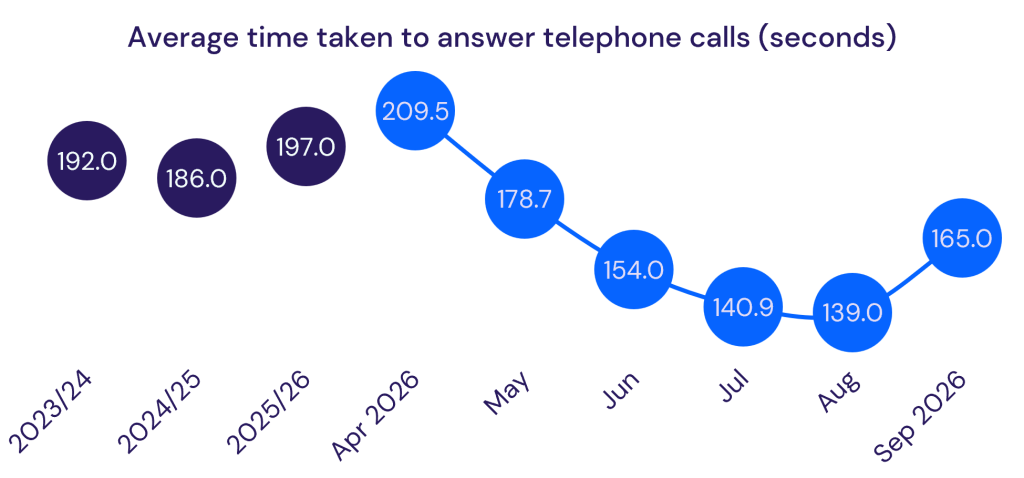
The September median of 165 seconds represents an increase from August but is lower than April and May. This is true across the sample, where we recorded improvement between April and June, broadly stable results during July and August followed by a deterioration in September.
This is set against a backdrop of some volatility in this measure. Of the 56 landlords supplying consistent data for six months, 53 reported monthly changes that reversed direction at least once, while two reduced month-on-month and one reported a continuous rise.
In our next issue of Pulse, we are looking at the customer experience in more detail, backed by a survey of professionals specialising in this key service. For more information, contact Housemark’s Research Manager, john.wickenden@housemark.co.uk.
This month’s trends
Complaints
The Housing Ombudsman’s 2026 Annual Complaints Review noted the English social housing sector’s improving complaint handling overall. While volumes have increased since the Ombudsman’s complaint-handling code was introduced, the proportion upheld at the Ombudsman stage has dropped, while cases where the Ombudsman has found reasonable redress have increased.
The trend of increasing complaints volumes has continued in 2026/27, with landlords recording a median of 7.66 Stage 1 and 2 complaints per 1,000 properties in September 2026. This is the highest result we have recorded for this measure since it became part of Pulse in April 2023.
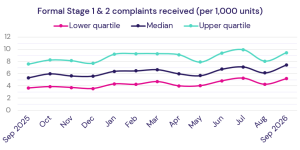
Using our unique insight, cross-referencing complaints with other measures in the dataset suggests that the increase is not related to a deterioration in service. Several factors have been put forward to explain the increase in complaints – including better awareness of the process, more repairs meaning more contact, and increased use of AI to ‘spin up’ a written complaint.
Pulse data highlights landlords’ ability to handle increasing volume without compromising performance. Despite higher repairs volumes, the proportion of complaints responded to in target improved by 1.5% compared to both August 2026 and September 2025.
Improvements in repairs, which is the most complained-about service, have also had an impact. While an increase in repairs volumes is a driver of more complaints, enhancements to the service mean that landlords have processes in place to provide reasonable redress when the system breaks down. This is reflected through improved overall perception as well as the outcome of cases reaching the Ombudsman.
If you would like to understand how a rise in complaints is driven at your organisation, contact us at consultancy@housemark.co.uk.
Staff turnover
September’s voluntary staff turnover median figure was 0.93%, which is a significant 26% year-on-year increase on the same month as 2025 and a 19% rise compared to August 2026. While we had expected this to occur (fewer employees are likely to leave one job and start another during the holiday period).
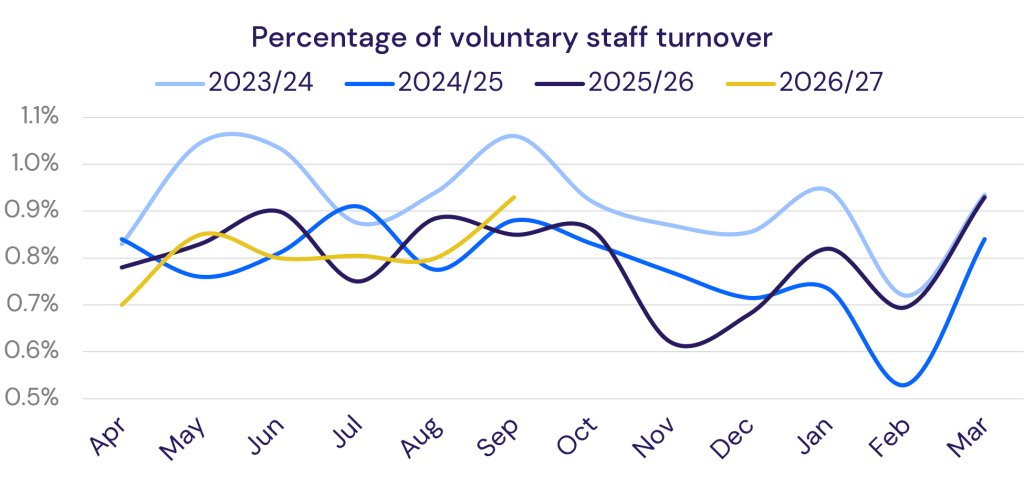
Voluntary turnover has only reached this monthly level once in the last two years. While the current jobs market appears quite static at a national level, we have found qualitative evidence of landlords finding positions hard to fill, with vacancies putting added pressure on colleagues remaining.
Our insight from Housemark members reveals several drivers of voluntary turnover, including:
- Wider regional competition as hybrid and remote workers from a large geographical base are attracted to higher salaries offered in London and other large cities.
- Retention difficulties amongst contact centre staff as landlords struggle to compete with lower-stress jobs with the same pay in other sectors.
- Increasing demand from residents with additional needs has led to many housing management staff seeking sideways moves into back-office roles or with suppliers.
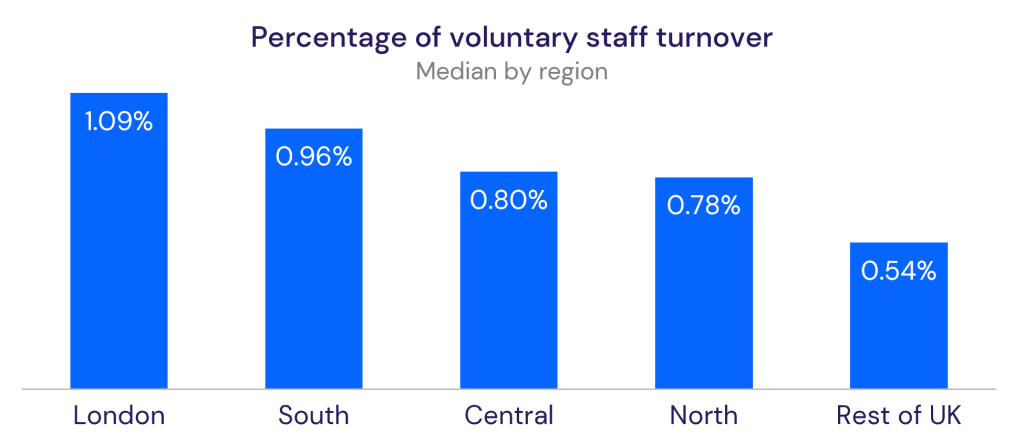
With budgets constrained by annual rent increases and competition from asset investment, and the rigours of the job unlikely to disappear, customer-facing housing looks set to face recruitment and retention challenges into 2027.
If you would like to discover more about how your employee packages compare to other landlords, contact consultancy@housemark.co.uk.
Customer experience
We started collecting and analysing Pulse data on average call waiting times in April 2026, after converting an established measure from an annual to a monthly cadence to provide landlords with relevant, timely metrics. While we have noticed a general long-term increase in the average number of seconds customers wait to speak to a contact centre agent, our six months of results are yet to show a strong pattern of this moving in either direction.
The September median of 165 seconds represents an increase from August but is lower than April and May. This is true across the sample, where we recorded improvement between April and June, broadly stable results in July and August followed by a deterioration in September.
This comes against a backdrop of some volatility in this measure. Of the 56 landlords supplying consistent data for six months, 53 reported monthly changes that reversed direction at least once, while two reduced month-on-month and one reported a continuous rise.
In our next issue of Pulse, we are looking at the customer experience in more detail, backed by a survey of professionals specialising in this key service. For more information, contact Housemark’s Research Manager, john.wickenden@housemark.co.uk.
In Focus: Competence and Conduct
The Sector is ready on paper, but is it ready in practice?
The new Competence and Conduct Standard came into force in England on 1 October 2026. Key requirements of the standard are for landlords to:
- Ensure that staff delivering housing services have the skills, knowledge, experience and behaviours needed to provide good-quality services.
- Maintain a written competence and conduct policy
- Embed an appropriate code of conduct
- Involve tenants and obtain assurance about the competence and behaviour of relevant service providers.
The intention is clear. Professionalism should be visible not only through qualifications, but in how residents are listened to, how poor performance is addressed and how consistently services are delivered. The challenge is that these requirements arrive at a time when landlords are already managing significant operational, regulatory and financial pressures.
To understand how ready organisations are, we surveyed 47 social landlords as the standard came into effect during October. The results suggest that the sector has made considerable progress, but there is a gap between having the right documentation and embedding the standard throughout everyday practice.
Confidence is high, but readiness is uneven
On average, respondents rated their readiness to meet all the requirements of the standard at 3.7 out of five. Seven in ten gave themselves a score of four or five, indicating a broadly confident sector.
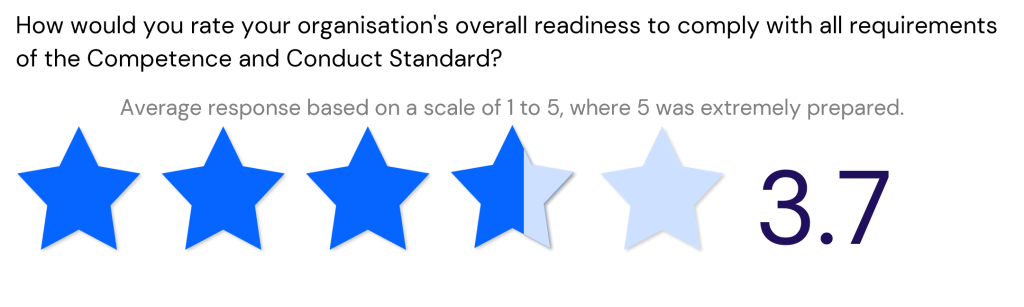
This does not suggest that whole organisations have been slow to respond. Most have recognised the standard, identified the main requirements and started putting the foundations in place. The more revealing finding is that progress is uneven within organisations. Policies, workforce development, contractor management and tenant engagement are not necessarily moving at the same pace.
Almost three-quarters of respondents had a written competence and conduct policy in place, but only around half of those organisations described it as well embedded. Codes of conduct were more common, with 87% reporting that one was in place, although again only around half said it was well embedded. A small minority did not expect their policy or code to be ready before the end of 2026.
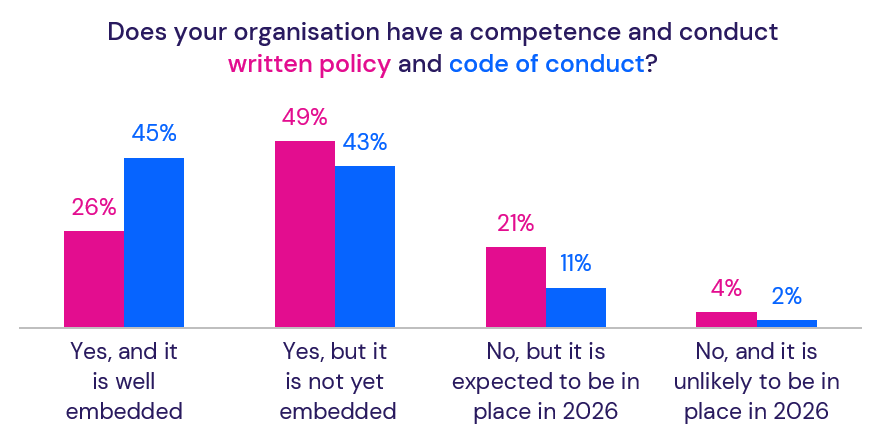
This distinction matters. The standard does not simply require an organisation to publish a document. Landlords must be able to demonstrate that expectations are understood, applied and regularly reviewed. A policy sitting on an intranet is not the same as managers using it in supervision, employees recognising how it applies to their role, or leaders receiving meaningful assurance about whether behaviours are changing.
Delivery is being placed in the hands of managers
When asked how they would ensure staff complied with their policy and code of conduct, most respondents described a manager-led approach.
Performance management, supervision, one-to-ones and management oversight were referenced by 58%. Training, induction and regular communication were identified by 47%, while 40% referred to monitoring, assurance or reporting. However, 21% were still developing or agreeing their approach and only 14% explicitly mentioned asking staff to sign or formally attest that they had understood the requirements.
This reliance on line managers is understandable. Conduct is most visible in everyday decisions and interactions, rather than in an annual training module. Managers are well placed to reinforce expectations, identify development needs and intervene where performance or behaviour falls short.
But this approach also introduces risk. Its effectiveness depends on managers having the time, confidence and consistency to apply the standard. If expectations are interpreted differently between services or teams, landlords may find it difficult to demonstrate that their policy is embedded across the organisation.
The strongest responses combined several forms of assurance. These included clear expectations in role profiles and induction, regular conversations through one-to-ones and appraisals, training records, workforce audits, customer feedback and reporting to senior leaders or boards. This provides a more reliable evidence trail than relying on policy publication or training completion alone.
Curo: Supporting people through change
Curo has reviewed its senior roles to identify which colleagues are within scope of the qualification requirements and has appointed a learning provider. Recognising that employees will have different levels of experience and support needs, Curo is offering a fast-track option alongside longer-term learning routes.
A dedicated colleague will support learners and monitor progress, while a learning cohort and Teams channel will allow participants to share their experiences and support one another. Curo has also consulted customers and colleagues on its Professional Standards Policy and Code of Conduct and is using the new standard to build on its existing “How we get things done” performance management approach.
The learning for the sector: Qualification planning should consider not only who is in scope and which course they require, but how employees will be supported to complete it. Flexible learning routes, peer support and dedicated oversight can help reduce some of the capacity and confidence issues identified through Housemark’s survey.
Qualifications are only part of the picture
The qualification requirements have attracted considerable attention. Senior housing managers are generally required to hold, or work towards, a relevant Level 4 qualification, while senior executives in scope require Level 5. Large landlords have a three-year transition period and smaller landlords four years.
Our survey found that 60% of respondents had identified the relevant staff and had scheduled or begun the necessary learning. A further 32% were still exploring qualification requirements and provider options. The remaining organisations were at different stages, ranging from identifying staff in scope to having all relevant qualifications already in place.
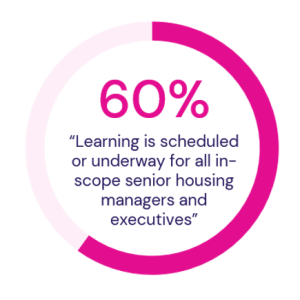 This represents substantial activity, but responses also reveal continuing uncertainty. Organisations raised questions about top-up modules, interpreting which roles are in scope and how to treat experienced staff who may be approaching retirement.
One respondent highlighted concerns about losing senior colleagues who have considerable knowledge but may not wish to undertake a lengthy formal qualification. Others pointed to anxiety about returning to study, the pressure of assignments and the operational impact of releasing managers for protected learning time. Similar concerns were identified by the Inside Housing Competence and Conduct Standard survey, which found that qualification costs extended beyond course fees to include staff cover, workload reduction, administration and learner support.
For landlords, the risk is therefore not simply whether employees enrol on time. It is whether organisations can create the capacity for people to complete qualifications successfully without increasing pressure on colleagues or reducing service resilience.
Contractor assurance is the biggest area of concern
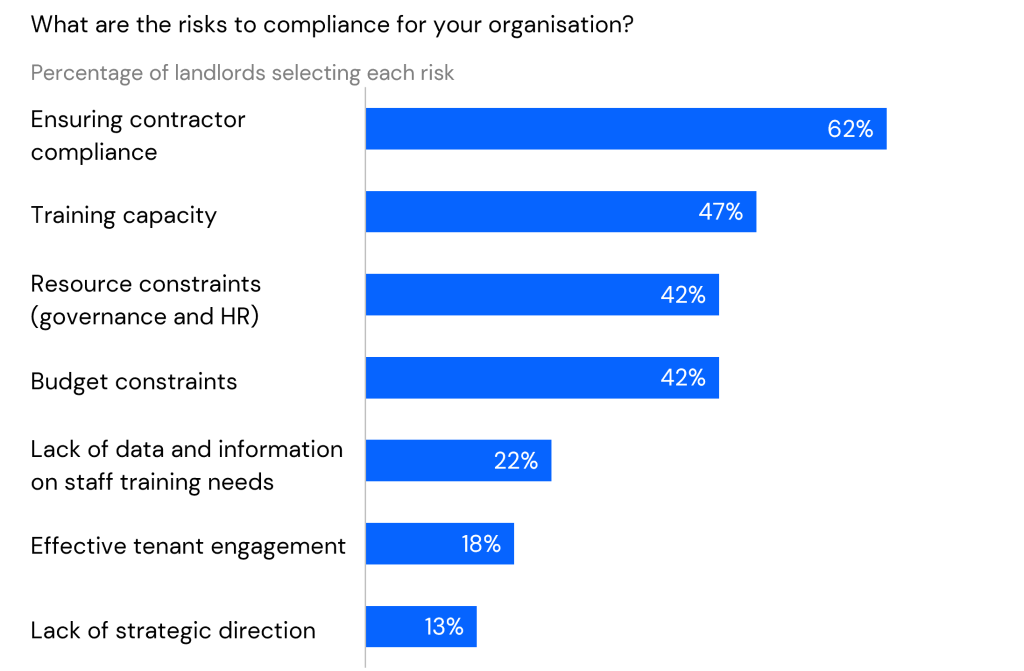
Ensuring contractor compliance was the most frequently identified risk, selected by 62% of respondents. This was followed by training capacity at 47%, and governance, HR and budget constraints, both at 42%.
More than half of landlords intended to incorporate competence and conduct expectations into procurement or contractual arrangements. The same proportion referred to contract monitoring and assurance, while 44% planned to use codes of conduct, communications or onboarding. However, 1 in 4 (26%) were still deciding or developing their approach.
This suggests the sector broadly understands what the mechanisms will be but has not always translated that understanding into an operational assurance framework.
Simply adding a clause to a future contract will not address every risk. Existing providers will need to understand the landlord’s expectations, and contract managers will need suitable evidence to assess compliance. This could include workforce and training information, complaints and customer feedback, audits, performance reviews and evidence that concerns about conduct lead to remedial action.
While contractors may only be in scope for the qualification part of the standard if they provide a comprehensive management service, there may still be other financial effects. Contractors face many of the same costs as landlords, including training, monitoring, administration and staff cover. It is reasonable to expect that some of these costs could eventually be reflected in tender prices or contract management charges. The external sector survey similarly reported concerns that additional compliance requirements could lead contractors to increase their prices, creating pressure on already stretched capacity and operating margins.
Tenant involvement may lose momentum after launch
The standard requires tenants to have meaningful opportunities to influence and scrutinise the development of the written policy and decisions relating to the code of conduct. Policies and codes must also be accessible to tenants.
Our survey found encouraging evidence of involvement during policy development. Almost two-thirds of respondents agreed that tenants had been given meaningful opportunities to influence the written policy, and a similar proportion said residents had influenced decisions about the code of conduct.
Resident panels, focus groups and scrutiny arrangements were referenced by 63% of respondents. Policy or code consultations were used by 58%, while 38% drew on surveys, complaints information or digital feedback.
However, the results were weaker when landlords were asked about accessibility and continued engagement. Only half agreed that their policy was accessible and easy for tenants to find, while 13% disagreed. Just over half had a plan to engage residents regularly as implementation continued.
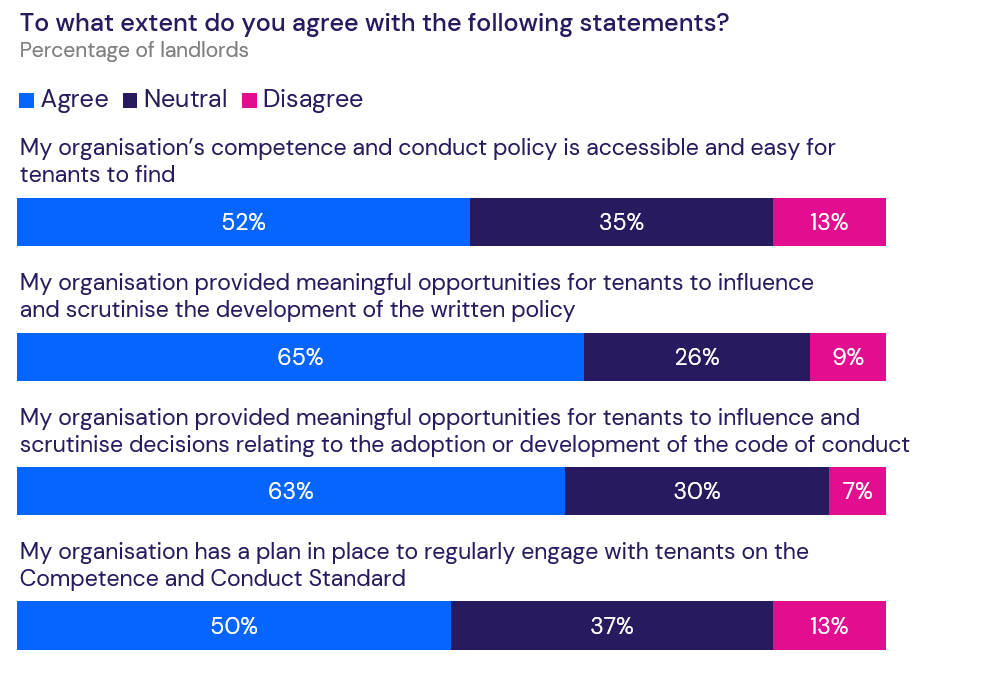 There is a risk that tenant engagement becomes concentrated around drafting and approving the policy rather than testing whether it makes a difference. Complaints, transactional feedback, tenant scrutiny and measures relating to fairness, respect and communication can all help landlords understand whether expected behaviours are being experienced by residents.
The next stage should therefore move beyond asking tenants whether they support the wording of a policy. It should ask whether they can see its principles reflected in the services they receive.
Southampton City Council: Putting residents at the heart of implementation
Southampton City Council has appointed a dedicated project lead to coordinate its response to the Competence and Conduct Standard. Its phased approach includes research and gap analysis, awareness-raising across housing and corporate services, resident and colleague engagement, policy development, reviewing the existing corporate Code of Conduct, and assessing whether systems and processes provide sufficient evidence and assurance.
The council is also considering implementation costs ahead of its 2027/28 budget-setting cycle and plans to pilot solutions within local teams before scaling them across housing services. Continuous monitoring and further resident involvement will then be used to refine the approach.
Residents are central to the council’s plans. Southampton intends to involve them from an early stage in shaping its policy and approach, while using clear resident-facing communications to explain what the Standard is, why it has been introduced and what changes residents should expect. The council sees the ultimate purpose of the Standard as improving the quality, consistency and professionalism of housing services and delivering better experiences and outcomes for residents.
The learning for the sector: Effective implementation requires more than identifying qualification needs. A structured programme, supported by dedicated ownership, budget planning, cross-organisational working, piloting and continued resident scrutiny, can help translate the requirements into sustained service improvement.
Another cost pressure in an already crowded environment
The government’s impact assessment estimates a net cost to the sector of £282.8 million, in 2025 prices, with an estimated annual net cost to business of £28.1 million. These estimates include qualification costs and the time required to undertake learning, but some of the wider implementation costs will be harder for individual landlords to isolate.
There will be costs associated with updating policies, mapping roles, procuring learning, releasing staff, collecting evidence, monitoring contractors and reporting assurance. In isolation, each may appear manageable. Together, they create another layer of cost and organisational complexity at a time when landlords are balancing investment in existing homes, regulatory compliance and development.
The latest financial forecasts from the Regulator of Social Housing indicate that the sector’s financial position may be beginning to stabilise, but that trade-offs remain difficult. Providers forecast £54.7 billion of new borrowing over the first five years of their plans, while the largest landlords generally continue to face a tighter financial position.
There is no evidence that the Competence and Conduct Standard alone will directly affect a landlord’s credit rating or borrowing costs. However, lenders and rating agencies will be interested in how organisations manage cumulative regulatory costs, workforce pressures, operational disruption and governance assurance. Poor implementation could therefore add to wider concerns about financial resilience and management capacity, particularly where interest cover is already constrained.
This makes it important for landlords to understand the full cost of compliance rather than treating course fees as the total investment required.
The biggest test is cultural, not procedural
Half of respondents identified capacity, time and competing priorities as a major implementation challenge. More than a quarter raised the difficulty of embedding long-term cultural and consistent change, and the same proportion highlighted qualification, top-up module or retirement concerns. Almost one-quarter referred to unclear guidance or uncertainty about what good implementation looks like.
One respondent summed up the challenge clearly: genuine cultural change is difficult and cannot be rushed. The organisation was concerned that the standard could be seen as “just another initiative from HR” while operational teams were already responding to Awaab’s Law, consumer regulation and other demands.
This is perhaps the most important finding from our survey. The sector is not generally confused about the purpose of the standard, nor has it failed to act. Instead, many organisations are in an intermediate position. The architecture is being built, but the evidence that it is embedded is still developing.
From compliance to resident outcomes
The longer-term test of the Competence and Conduct Standard will not simply be whether organisations can demonstrate that staff are appropriately qualified. It will be whether investment in skills, behaviours and professional development can be linked to tangible improvements in the services residents receive.
Customer practice: Dacorum Borough Council
Dacorum Borough Council is taking a structured, outcome-focused approach to implementing the Competence and Conduct Standard, linking workforce development to improved resident experience and service performance.
The council began by assessing colleagues delivering landlord services across both the council and commissioned service providers. This established that 46% of in-scope staff currently hold, or are working towards, an appropriate qualification. Using this understanding, Dacorum Borough Council has developed a phased programme that will establish a full route to compliance by September 2029.
Alongside compliance planning, the council is strengthening its approach to learning, development and professional standards, while ensuring residents are able to shape and scrutinise delivery.
Creating a positive learning culture has been a key part of this work to date. Through quarterly Housing Breakfast Clubs, Dacorum Borough Council celebrates colleagues who have gained professional qualifications or completed significant development programmes, helping to reinforce the value placed on learning and continuous improvement.
“Our ambition is for the Standard to drive meaningful improvements for tenants, not just satisfy regulatory requirements.”
To measure success, Dacorum Borough Council has aligned the Standard with key Tenant Satisfaction Measures. In particular, it wants to see improvements in whether tenants feel they are treated fairly and with respect, alongside improvements in its approach to managing complaints.
By linking workforce development to resident outcomes, the council aims to use the Standard as a catalyst for lasting service improvement and increased tenant confidence in its services.
Dacorum Borough Council’s approach highlights an important shift from measuring compliance through qualifications and policies alone, towards considering whether greater competence and professionalism translate into better outcomes for residents.
From compliance to lasting change
Policies, codes and qualifications are necessary foundations. The longer-term measure of success will be whether managers make better decisions, staff feel equipped and supported to act professionally, contractors meet the same expectations as employees, and tenants experience more respectful, responsive and consistent services.
The standard came into force on 1 October, but implementation will continue for several years. Landlords that treat it as a deadline-driven compliance exercise risk creating another layer of process without achieving meaningful change. Those that connect it to workforce planning, performance management, customer insight, procurement and organisational culture have an opportunity to strengthen services and rebuild resident confidence.
Our survey suggests that most landlords have started that journey. The next challenge is turning readiness on paper into consistent practice.
Latest news and insights



Month in numbers: September 2026
The results in the table below have been calculated based on submissions from 150 social landlords.
Open an Excel version of this table
| Measure | Lower Quartile | Median | Upper Quartile | Change (Aug-Sep) |
| Repairs and maintenance | ||||
| Percentage of homes with a valid gas safety certificate | 99.82% | 99.96% | 100.00% | 0.0% |
| Percentage of homes for which all required electrical safety checks have been carried out | 98.51% | 99.57% | 99.93% | 0.0% |
| Responsive repairs completed (per 1,000 units)* | 242.0 | 294.8 | 322.0 | 16.3% |
| Percentage of non-emergency responsive repairs completed within target | 81.0% | 87.3% | 93.4% | 0.1% |
| Responsive repairs outstanding (‘work in progress’) | 9.2% | 5.5% | 3.5% | -3.2% |
| Satisfaction with repairs (transactional) | 84.3% | 89.0% | 93.7% | -0.7% |
| Housing management | ||||
| ‘True’ current tenant arrears | 3.70% | 2.76% | 1.93% | 1.5% |
| Percentage of dwellings vacant but available to let | 0.90% | 0.57% | 0.23% | 7.9% |
| Average re-let time in days (standard re-lets) | 70.8 | 44.2 | 31.8 | -2.6% |
| New ASB cases reported (per 1,000 units)* | 1.88 | 3.20 | 5.54 | -9.9% |
| Customer experience | ||||
| Formal Stage 1 & 2 complaints received (per 1,000 units)* | 5.19 | 7.44 | 9.45 | 21.7% |
| Percentage of Stage 1 & 2 complaints resolved within timescale | 87.4% | 97.9% | 100.0% | 1.5% |
| Percentage of customer contact received via digital channels* | 28.2% | 37.8% | 49.0% | -2.3% |
| Average time taken to answer inbound telephone calls (in seconds) | 341.0 | 165.0 | 88.0 | 12.6% |
| Satisfaction with the service their landlord provides (perception) | 72.0% | 76.0% | 80.5% | 1.5% |
| Staffing | ||||
| Percentage of working days lost to sickness absence | 4.8% | 3.8% | 3.1% | 4.1% |
| Percentage of voluntary staff turnover | 1.3% | 0.9% | 0.5% | 19.2% |
| Awaab’s Law | ||||
| New emergency hazards reported per 1,000 properties* | 11.9 | 51.6 | 82.6 | 20.2% |
| New significant damp and mould hazards reported per 1,000 properties* | 0.7 | 2.0 | 7.7 | -15.9% |
| Percentage of emergency hazards resolved within 24 hours | 92.0% | 98.4% | 100.0% | -0.6% |
| Percentage of significant damp and mould hazards investigated within 10 working days | 84.2% | 99.0% | 100.0% | 0.2% |
| Percentage of significant damp and mould repairs initiated within 5 working days | 89.0% | 100.0% | 100.0% | 0.9% |
The quartiles presented in this table are presented with polarity, which means that Upper Quartile always represents the most favourable quartile. Some KPIs don’t have a polarity (indicated with a * next to the measure name) – meaning that neither high or low values are better. In these instances, Upper Quartile represents the largest values and Lower Quartile, the lowest.