Artificial intelligence is no longer an abstract concept on the fringes of the social housing sector. From automated tenant triage to predictive asset management, tools are embedding themselves across housing associations, local authorities, and ALMOs at pace.
Yet beneath the headlines and vendor promises, a critical gap is emerging between grassroots experimentation and true organisational transformation.
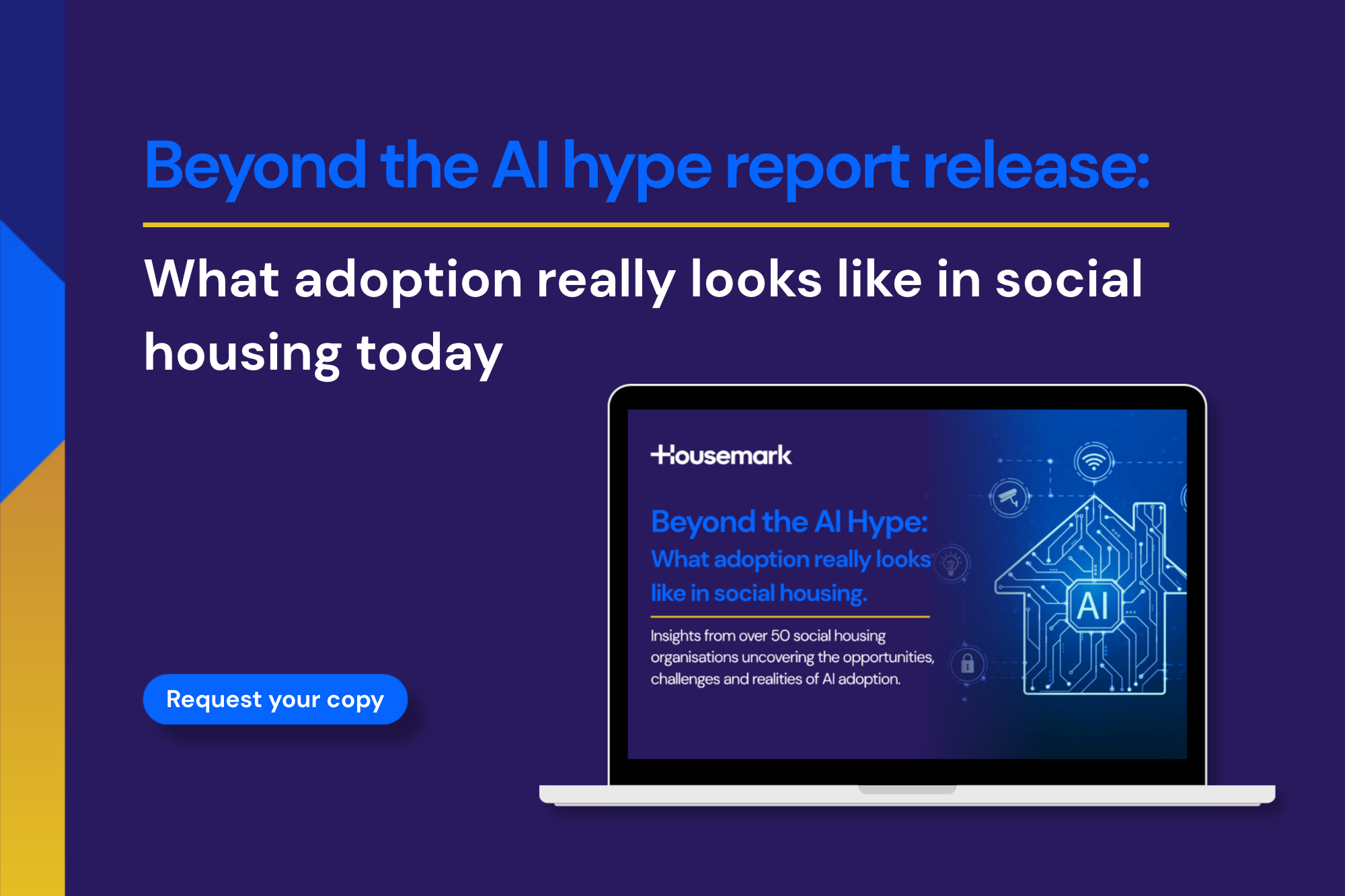
Housemark’s forthcoming whitepaper, Beyond the Hype: What AI Adoption Really Looks Like in Social Housing, draws on comprehensive research across the sector to uncover how landlords are actually funding, implementing, and governing AI. The data shows an ambitious sector moving quickly, but one that faces distinct operational and technological roadblocks.
The Reality of AI Adoption in Social Housing
Every week brings new product announcements and productivity tools, but how much of this activity translates into better frontline services, robust decisions, and demonstrable return on investment?
The findings from our sector-wide study indicate that while individual use of AI is widespread, organisational adoption remains fragmented:
Adoption is outrunning strategy: Only 11% of housing providers currently have a formal AI strategy in place.
On the agenda, but missing from budgets: Just 11% of organisations report having a ring-fenced AI budget.
The measurement deficit: 70% of organisations are not tracking or measuring the business impact of their AI tools.
The legacy barrier: 73% state their core housing management and business systems offer limited or no support for AI integration.
The takeaway is clear: housing professionals are actively seeking efficiency, but organisations risk accumulating disjointed, ungoverned tools rather than building scalable capability.
Moving Beyond Isolated Experimentation
To unlock long-term value from artificial intelligence, housing providers must transition from ad-hoc experimentation to structured implementation. Doing so requires addressing three core pillars:
- Bridging the Strategy and Budget Gap
When AI adoption is driven exclusively from the bottom up, tools tend to solve isolated personal productivity tasks rather than strategic organisational challenges. A formal AI roadmap ensures that investments align with core objectives, such as tenant satisfaction, asset compliance, and repairs efficiency, while securing the dedicated funding required to scale.
- Overcoming Legacy System Constraints
The research highlights that 73% of providers struggle with core legacy systems that offer limited AI interoperability. Achieving true transformation means looking critically at data foundations. Without clean, integrated, and accessible data, advanced tools cannot deliver reliable insights or automate workflows safely.
- Governance, Accuracy, and Measurable ROI
Adopting AI responsibly in social housing requires transparent governance, strict data privacy safeguards, and clear risk frameworks. Crucially, organisations must move beyond anecdotal time-savings to formal measurement, establishing clear baseline metrics to prove demonstrable return on investment to boards and tenants alike.
A Practical Roadmap for the Sector
The report gathers insights from across the entire social housing hierarchy, from C-suite executives defining long-term strategy to operational leads managing frontline delivery. It provides a benchmark of where the sector stands today and sets out practical priorities for the next 12 months, exploring:
- The current maturity curve of AI adoption across UK social housing
- Where organisations are already seeing measurable value and efficiency gains
- Governance, compliance, and security considerations tailored to social landlords
Register for Exclusive Launch Access
The full whitepaper, Beyond the AI Hype: What AI Adoption Really Looks Like in Social Housing, will be made freely available to everyone across the social housing sector.
Register today to receive the report directly to your inbox as soon as it launches: