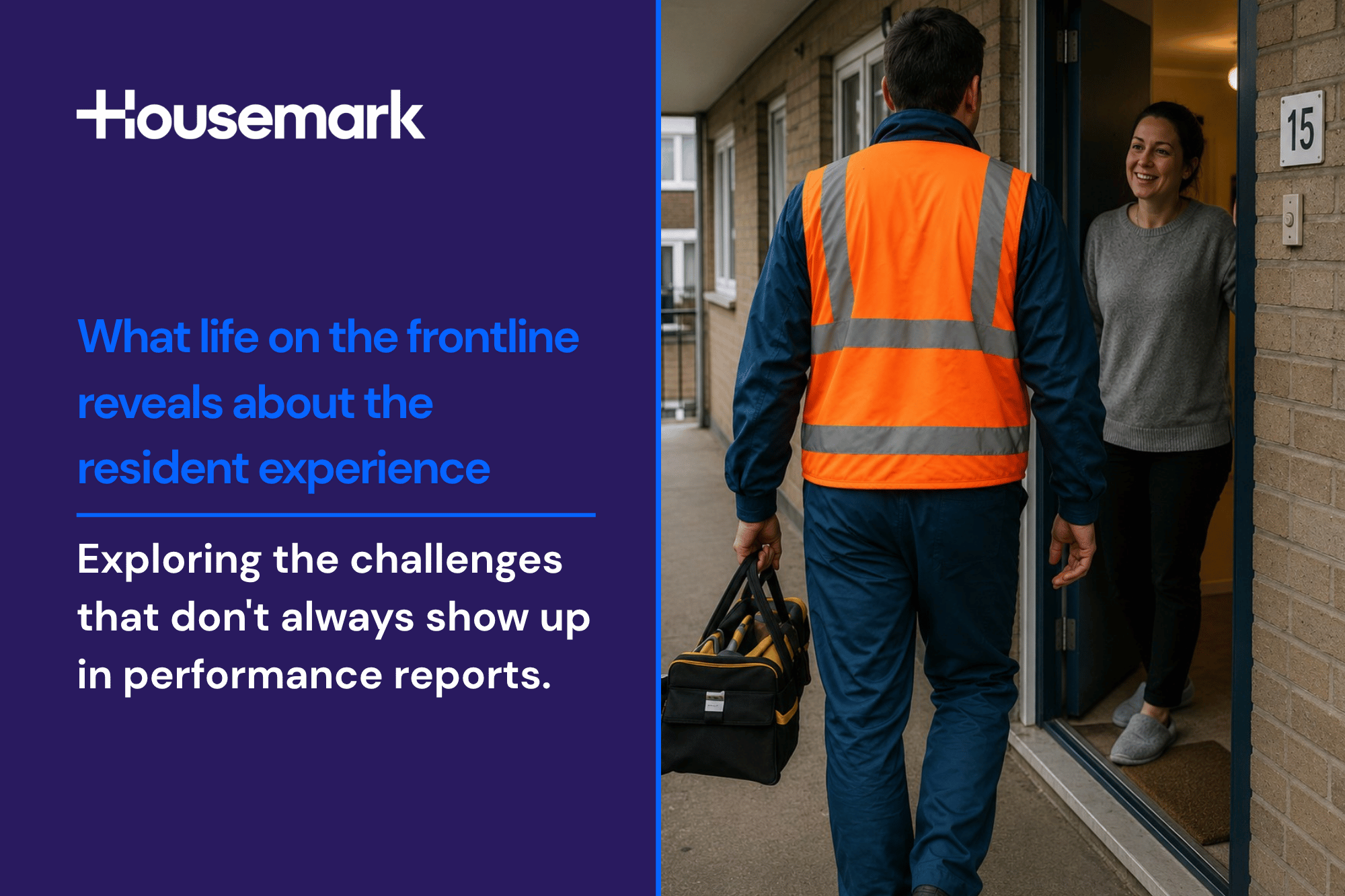
I recently sat down with Joe Carpenter to discuss what life on the frontline reveals about resident experience, organisational culture and the challenges that don't always show up in performance reports.
One of the most rewarding parts of my role is hearing directly from the people delivering services on the frontline. Recently, I had the opportunity to sit down with Joe Carpenter to discuss what life on the frontline reveals about resident experience, organisational culture and the challenges that don’t always show up in performance reports.
Joe is a social housing maintenance operative with more than a decade of frontline experience and over 14,000 repairs completed across London and the South East.
Working across voids, reactive repairs and resident-facing services, his career has taken him behind thousands of front doors, giving him a unique perspective on the realities of social housing, the pressures facing frontline teams and the experiences of the residents they serve.
Throughout our conversation, Joe highlighted a theme that runs through much of his work: the importance of looking beyond performance figures to understand the people and stories behind them. From building trust during a repair visit to navigating increasingly complex resident needs, his insights offer a valuable frontline perspective on what drives good service delivery and how housing organisations can continue to improve outcomes for residents.
Through his writing, Joe explores the space between residents and housing organisations, shining a light on the practical challenges, human interactions and everyday decisions that shape life in social housing.
The story (and people) behind the numbers
Your book, Middle Ground, captures the space between residents, frontline staff and housing organisations. What inspired that title, and what does that frontline perspective reveal about social housing that we don’t always see through reports, policies or headlines?
Firstly, thank you to Housemark and the team for the opportunity to contribute.
Middle Ground is the space I saw between residents and housing organisations. That space was the inspiration for the title. I wanted to shine a light on a part of the sector that often gets overlooked: the frontline workforce. Whether you’re an operative, a housing officer, a neighbourhood manager or another member of staff working directly with residents, there are times when you can feel caught in the middle, balancing resident expectations with the demands, priorities and pressures of the organisation you work for.
My own experience is as a maintenance operative, so that’s the perspective I write from. I don’t claim to speak for every frontline role, but I do think those working directly with residents often see things that are difficult to capture in reports and performance data. They see the frustration when a repair takes months instead of days, the relief when a long-standing problem is finally resolved, and the impact poor communication can have on trust. They also see the practical obstacles that rarely make it into a report, like incorrect diagnoses, missing parts, incomplete information, unrealistic workloads and the countless small decisions that affect whether a repair is completed successfully or becomes another repeat visit. That was the story I wanted to tell.
Repairs satisfaction has seen one of the biggest improvements in our latest TSM results. Readers of Middle Ground comment that, for many residents, the repairs team is the landlord. What does that relationship reveal about resident experience that housing organisations may not always see?
I think that’s true. For many residents, the repairs team is the landlord because they’re often the people they see most. They may never meet a director or a senior manager, but they will remember the person who came into their home, how they spoke to them and whether they felt their concerns were taken seriously.
One thing I don’t think is always recognised is how much trust can be built, or lost, during a repair visit. Residents are inviting someone into their home, often at a time when they’re already frustrated or worried. Taking the time to explain what is happening, listening to their concerns and treating them with respect can completely change that experience.
For me, that’s why repairs are about much more than fixing something that’s broken. Every visit is an opportunity to build confidence in the organisation. The quality of the repair matters, but so does the quality of the interaction. In many ways, that is the service residents remember long after the repair has been completed.
With repairs being such a strong driver of resident satisfaction, sustaining performance is just as important as improving it. In your experience, where are the biggest opportunities for housing organisations to strengthen the journey between a repair being reported and a member of staff arriving at a resident’s door?
People often think a repair starts when the operative arrives, but in reality, it starts with the first conversation. That’s where expectations are set, information is gathered, and the job begins to take shape.
Was the repair diagnosed correctly? Was the right information captured? Has the resident been given a realistic expectation of what will happen next? Small mistakes at the beginning of the process can create frustration later, for both residents and frontline staff.
From an operative’s perspective, good preparation makes a huge difference. Having the right information, the right materials and enough time to do the job properly helps create a better experience for everyone. Too often, operatives can arrive at a property and find that the information they have been given does not reflect the reality of what is in front of them. That can lead to delays, repeat visits and frustration for the resident.
There is also an opportunity to look beyond speed as the measure of a good repairs service. Completing a repair quickly is important, but so is doing it properly, communicating clearly and taking ownership when things do not go to plan.
The journey between reporting a repair and someone arriving at the door involves many different teams and decisions. Improving that journey means breaking down those silos and recognising that every stage has an impact on the resident’s experience.
The operative might be the person the resident sees, but the quality of that visit is often shaped long before they arrive.
At Housemark, helping landlords understand performance, resident experience and sector trends through data is what we do every day. Are there any metrics the sector places too much emphasis on, and what would you like to see measured more effectively to better reflect the experiences of residents and frontline teams?
I don’t think the issue is that the sector measures too much; it is that sometimes it puts too much weight on individual measures without understanding the story behind them.
Targets and performance figures are important, but they can only tell part of the picture. A repair completed within a target time does not necessarily mean it was a good repair. It does not tell us whether the resident felt listened to, whether the operative had the right information, whether the issue was fixed the first time properly, or whether someone had to chase the social landlord several times to get there.
One of the biggest challenges in repairs is that the numbers can sometimes hide the reality on the ground. A service can look successful on paper while residents and frontline staff are experiencing something very different.
I would like to see more focus on the quality of the interaction and the journey behind the repair. Were appointments kept? Was communication clear? Did the resident understand what was happening? Did the operative have the tools, materials and information needed to resolve the issue? I also think we need to listen more to frontline teams. Operatives, housing officers and other colleagues who work directly with residents see patterns every day that may not appear in performance dashboards. They often know where processes are creating problems before those issues show up in the data.
Data is essential, but it should be used as a starting point for understanding a service, not the complete picture. The numbers tell us what is happening; the experiences of residents and frontline staff help explain why.
Pressures & policy
From your experience, how much influence does organisational culture have on the quality of repairs and services residents receive, and what are the hallmarks of a culture that consistently delivers high standards?
I think organisational culture has a huge influence on the service quality residents receive. You can have the best systems, policies and procedures in place, but ultimately it is people who deliver the service, and the culture around them shapes how they approach their work.
A good culture starts with recognising that repairs are not just transactions. The person carrying out the repair is entering someone’s home, and the way they behave, communicate and take pride in their work has a lasting impact on how those residents view the organisation.
In my experience, organisations that consistently deliver high standards are the ones that set clear expectations and support their people to achieve them. They value good workmanship, they listen to frontline staff, and they understand that quality and efficiency should not be seen as opposites.
Leadership also plays a huge role. Supervisors and managers influence what behaviours become accepted within a team. If people who take pride in their work and do things properly are recognised and supported, that becomes part of the culture. Equally, if poor standards are ignored or rewarded because someone appears to be delivering high numbers, those behaviours can quickly become normalised.
A strong culture is one where everyone understands the purpose behind the service. It is not just about completing jobs; it is about providing safe, decent homes and treating residents with respect. When staff feel valued and understand that their work matters, residents usually feel the benefit.
As Awaab’s Law and the Competence and Conduct Standard come into force by the end of 2026, expectations around accountability and professionalism are continuing to evolve. In your Substack, you write that “good workmanship has nothing to do with the postcode”. How can housing organisations embed that mindset into everyday service delivery?
Every resident deserves the same level of professionalism, respect and care, regardless of tenure or postcode. The phrase “good workmanship has nothing to do with the postcode” came from a recent article I wrote after working alongside someone who used the expression, “That’ll do, it’s only council.” I’ve always remembered them and that saying because it reflected an attitude that has no place in housing. The standard of work should never change because of who lives in the property or who owns it.
Social housing is sometimes viewed differently from other forms of housing, and those perceptions can influence expectations. There is a risk that standards are not consistently challenged, or that residents do not always receive the level of service they would expect elsewhere.
Embedding that mindset starts with culture. Organisations need to be clear that quality is not optional and that every repair matters. A leaking tap, a faulty door or a damaged kitchen unit may seem like a small issue from the outside, but for the person living there it is their home.
It also means valuing the skills and professionalism of frontline teams. Operatives need the right training, tools, and materials, and the time to carry out work properly. The Competence and Conduct Standard is important because professionalism is about more than technical ability; it is also about behaviour, communication and treating every resident with dignity and respect.
Ultimately, organisations set the standard by what they are prepared to accept. If poor workmanship is challenged and good workmanship is recognised, high standards become part of the culture rather than something that only matters when things go wrong.
The Future of social housing services
Our Housing Futures research found that frontline housing staff are increasingly supporting residents with challenges beyond housing alone, from mental health to wider wellbeing needs. Was that your experience from the repairs side, and how has that changed the role of frontline teams?
Yes, that has very much been my experience from the repairs side. If you work in repairs today, you have to accept that half the job is practical and half the job is about people.
The practical side is what most people think of first: diagnosing problems, carrying out repairs safely and leaving a resident’s home in a better condition than when you arrived. But the other side of the role is understanding the person behind the repair.
You are often walking into someone’s home at a point where something has gone wrong. It might be a broken heating system, a leak, damp and mould, or something that has been causing frustration for weeks or months. The way you communicate, the way you listen and the respect you show can be just as important as the repair itself.
Operatives aren’t hired to be social workers or replace other support services. Unfortunately, that has increasingly become part of the reality of the role over the last decade, as austerity and pressure on public services have reduced the wider support available to many residents. Because operatives are regularly entering people’s homes, they are often in a position to notice when something doesn’t seem right. That might be a resident who is struggling, someone who is isolated, or a situation where a little understanding and the right referral could make a difference.
The challenge is that this wider role is not always recognised. Frontline teams are expected to deliver a technical service while also managing increasingly complex human situations. That is why organisations need to support their staff with the right training, time and clear pathways to raise concerns.
Looking ahead, if the sector could make one practical improvement over the next 12 months to improve outcomes for residents, what would you make a priority—and what should sector leaders be focusing on right now?
Social landlords are investing significant sums into their repairs services, and rightly so. The challenge now is making sure that investment delivers the best possible outcomes for residents. If I had to choose one practical priority over the next 12 months, it would be to put more focus back on the foundations of service delivery, and that starts with the quality of the workforce.
No system, process or performance framework can deliver a good service without skilled and committed people behind it. The sector needs to value the trades and frontline teams who deliver services every day, invest in their development and make sure the right people are recruited, trained and supported.
This also means getting the basics right: accurately diagnosing repairs, having the right information at the start of the process, ensuring staff have the right tools and materials, and giving people the time to carry out work properly. It means having skilled people with the right training, making sure appointments are realistic, listening to frontline feedback and understanding the importance of getting things right first time. Staff can only deliver a good service if the organisation around them enables them to do so.
I also think sector leaders need to spend more time listening to frontline teams. Operatives, housing officers and other colleagues working directly with residents often spot problems long before they appear in performance reports. They understand where processes are working, where they are creating unnecessary frustration and what practical changes could make the biggest difference.
The focus on accountability, competence and professionalism is rightly increasing, but these cannot just exist in policies. They have to be reflected in the people delivering services every day and the culture organisations create around them. Ultimately, better outcomes for residents will come from investing not just in repairs services, but in the people who deliver them.
Service transformation is rarely straightforward, and it certainly doesn’t happen overnight.
As the social housing sector continues to evolve, landlords need the confidence, insight and practical support to improve services, strengthen compliance and deliver better outcomes for residents. Housemark’s Service Improvement & Transformation consultancy helps organisations at every stage of their journey, from reviewing customer experience and complaints handling to strengthening performance frameworks, regulatory readiness and service delivery.
Whether you’re looking to:
- Build the capability and confidence of your teams
- Create a more data-driven approach to decision-making
- Strengthen customer experience and resident trust
- Improve service performance and operational effectiveness
- Prepare for regulatory scrutiny and future sector challenges
Our experts can help you identify opportunities for improvement and create a practical roadmap for change.
Discover how Housemark’s Service Improvement & Transformation consultancy can help you deliver better services, stronger compliance and greater resident trust.