Keep your finger on the pulse
Issue 62: June 2026

With a change of UK Prime Minister imminent, there is much speculation in the media about the direction of travel for government policymaking. Although changes to the housing sector’s more stable policy landscape are not expected, a change in Chancellor will be one to watch given the current economic headwinds.
Jonathan Walters, the new RSH CEO, has been outlining his vision for a financially resilient sector that embraces innovation while managing risk. He has been publicly talking about the importance of economic regulation, the link between good governance and increased supply and how private capital and partnerships can increase capacity.
This month’s trends
Building safety
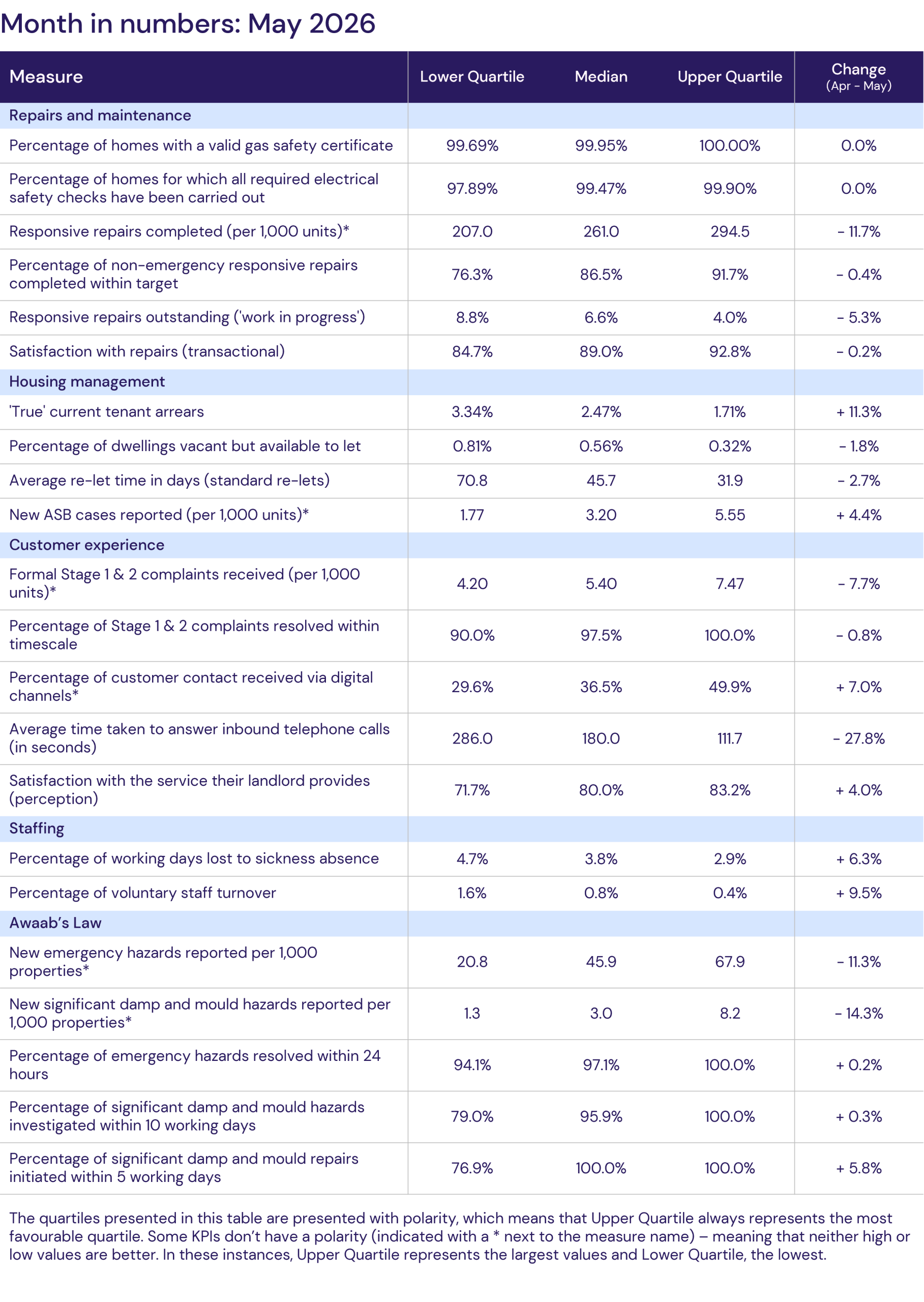
The Regulator of Social Housing’s newest Tenant Satisfaction Measure for English social landlords went live on 11 June 2026 following a lead-in period of several months. Focusing on Electrical Safety, TSM BS06 is similar to gas (BS01) in that full compliance requires safety checks within each home plus any communal installations serving the dwelling. We have adopted this regulatory definition in our Pulse data collection for 2026/27, superseding the previous measure that focused solely on domestic dwelling safety checks.
Following this update to our electrical safety measure in Pulse, the median result has fallen back by a fraction of a percentage point. This highlights the effect of taking into account a wider range of installations in the calculation of this measure.
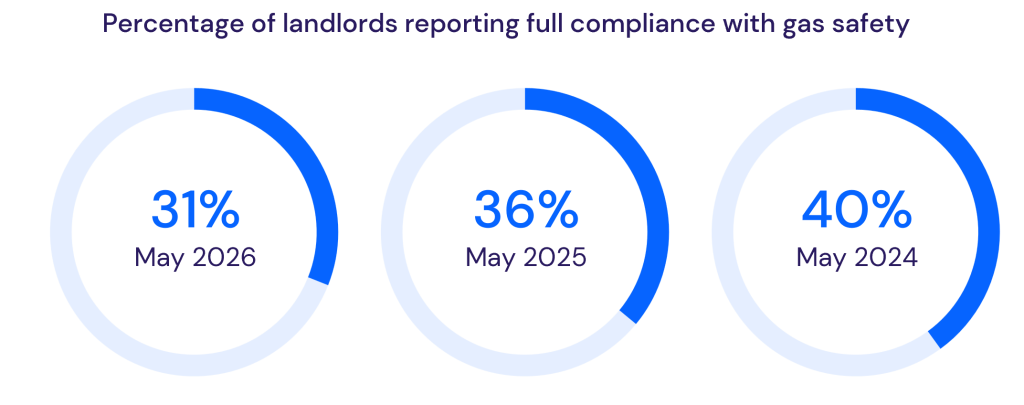
While the median for gas safety has continued to be just under 100%, the proportion of landlords recording full compliance with this measure has also fallen. In May 2026, less than 1 in 3 landlords (31%) recorded full compliance with gas safety in the month. This compares to 36% in May 2025 and 40% in May 2024 (unbalanced panel), indicating a downward trend in overall compliance metrics.
Feedback from Housemark’s Safety and Quality forum group of maintenance and asset management teams shows that the key reason for this fall is largely access. Programmes managing gas safety are well-embedded with legal barriers around gaining access when a tenant is unable or unwilling to cooperate.
The National Federation of ALMOs’ Opening the door report in 2025 explores this complex issue, recommending better communications, systems, and data, with the emphasis that ‘no access’ is not simply ‘no one answered the door’. This is a sensitive topic that has trust at the heart of it, as well as additional complexities such as mental health and vulnerability. The Chartered Institute of Housing has taken this research forward and launched a campaign urging the UK Government to back access powers in the Social Housing Bill announced in the King’s speech.
Voids and lettings
The start of the new financial year has shown little improvement in voids and lettings results measured through Pulse. April and May 2026 data reveals that re-let times continue at 6-7 weeks, while vacancy rates hover at 0.56%. The operational complexities and rising regulatory requirements during void periods, in addition to strategic considerations about stock presence and availability, are all contributing to results that refuse to move in the right direction. With data indicating a prolonged, systemic challenge, we continue to see both much-needed homes and financial capacity depressed.
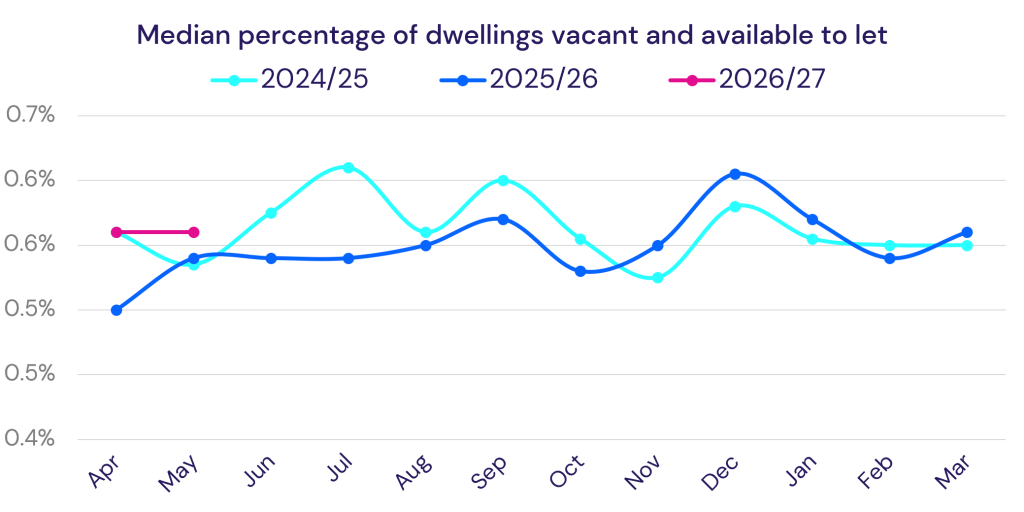
While the issue with extended re-let times is evident across much of the UK, it is particularly acute for English landlords, where consumer regulations are not focused on managing the period when a property is empty. Qualitative data from our research has found that there is simply no silver bullet to improve voids and lettings. Each part of the process needs careful consideration to maximise efficiency and minimise ongoing issues.
On top of operational concerns, landlords’ leadership teams need to understand what good looks like for voids and lettings in 2026; the conversation between strategic and operational management needs to be about more than just numbers – with culture, investment and relationships playing a large part in any successes in this area.
Housemark’s Voids Forum explores this topic in detail by sharing the experience and practice between operational managers from across the social housing sector. Covering all aspects of the process from keys and carpets to viability and accessibility, this networking opportunity is an ideal place to listen, understand, benefit from best practice and make the changes that will improve your voids and lettings performance and start to move the dial in the right direction.
Arrears
Between April and May 2026, the median rate of arrears increased 11% for landlords taking part in Pulse. This change is unusually high but, taken in the wider context, is not any cause for concern; the result records backlogs in benefits adjustments following April’s rent increase, so should be considered an anomaly.
The median figure we recorded in April (2.37%) was the lowest in four years of Pulse data – the result for May is still lower than the year-end figure in March. In addition to this, the year-on-year result (based on a balanced panel) showed only a 1% fall.
Going back over a longer period, Pulse results show that the median result was around 3% during the summer and autumn of 2024. With recent median results around 2.5%, we estimate that the UK social housing sector has reduced arrears by around £130m in less than two years, demonstrating that specialist teams, supported by data and technology, are creating capacity in the system compared to other operational areas that are still navigating complexity.
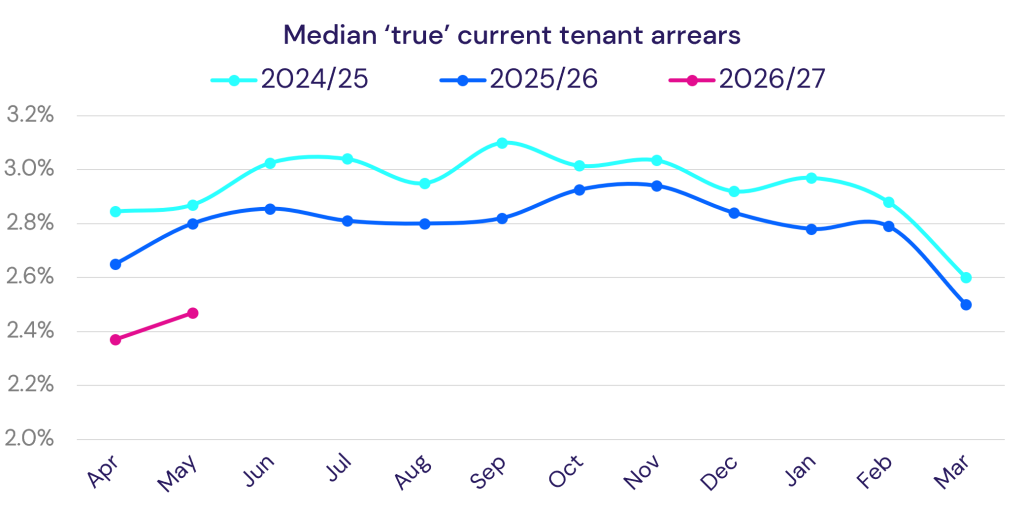
Our analysis of these results concludes that, while we experience seasonal fluctuation in arrears, rates continue to improve over the longer term as landlords improve processes to maximise income and minimise debt through effective place-based management models devolving decision-making to local teams who understand the area. If you would like to find out more about how your rent collection function compares and how your decisions and tactics are likely to deliver results, contact consultancy@housemark.co.uk.
In Focus
Awaab’s Law Phase 2 – Readiness for the next challenge
Awaab’s Law is reshaping how social landlords handle serious housing hazards, setting statutory timeframes for English registered providers to investigate and resolve reported defects in tenants’ homes. Phase 2 of Awaab’s Law, due in 2026, will expand the scope of significant hazards subject to strict timeframes.
In addition to damp and mould significant hazards, Phase 2 will cover a further 13 hazards under the Housing Health and Safety Rating System (HHSRS), including:
- excess cold and heat
- various types of falls
- structural collapse and explosions
- fire and electrical safety risks
- hygiene – domestic, pests, personal, sanitation
- food safety hazards.
Social landlords must be ready to manage this broadening of responsibilities, since the same standards and deadlines will likely apply to all these hazards, pending final regulations from Parliament. Outside England, regulatory bodies in Scotland and Wales have introduced similar Awaab’s Law provisions, focusing mainly on damp and mould.
Even before Phase 2 commences, the operating context has shifted. The Regulator of Social Housing (RSH) introduced new Consumer Standards for English social landlords in 2024, including a Safety and Quality Standard that explicitly requires providers to maintain homes free of serious hazards and have robust, up-to-date knowledge of building safety and condition. Awaab’s Law and the evolving regulatory regime are complementary – the law sets minimum legal deadlines for urgent repairs, while RSH’s standards demand proactive hazard management and data-driven assurance that tenants’ homes meet the new bar for safety and quality.
Ensuring compliance with Phase 2 will require revisiting internal definitions and triage processes. Landlords need to be clear on what counts as a “significant” hazard in each of the new categories – for example, defining the threshold of “significant domestic hygiene hazards” (accumulated waste or pest infestation), or what constitutes a falls hazard that warrants emergency or urgent action. Clarity is critical, and from our exclusive analysis and reporting of Awaab’s Law Phase 1 implementation, we know that many landlords have struggled with this.
We conducted a Pulse survey for this report asking landlords about preparations for Phase 2 of Awaab’s Law. This reveals a feeling that initial guidance for Phase 1 emerged quite late, leading to some confusion: one respondent noted “Although we are now confident that we are meeting all regulatory requirements, the reporting has been inaccurate due to only damp and mould cases being counted in the emergency numbers rather than all emergency hazards.” This highlights how consistent categorisation and data capture are pre-requisites for compliance – landlords must refine their methods to identify, log and track all Phase 2 hazards accurately from the time a tenant first reports a problem.
Critically, the same tight deadlines that applied to damp and mould under Phase 1 are expected to apply to Phase 2 hazards as well. This uniform timeline across many hazard types means that landlords’ repairs and health & safety teams may face a sudden increase in caseload under statutory deadlines.
For smaller providers in particular, the jump from one hazard category to 13 categories is a step change that could transform a manageable tracking task into a significant, complex operational consideration.
How prepared do social landlords feel for Awaab’s Law’s next phase?
Our latest Pulse survey results suggest most of the sector is still some way from full readiness. Only 4% of responses classified their organisation as “very prepared”, compared to nearly half who said they are only “somewhat prepared”, with the rest at either neutral or unprepared. Through qualitative respondent insight, we heard: “It’s hard to prepare really well for Phase 2 when exact parameters on what will be measured and how are yet to be determined.” A common sentiment is that the lack of finalised guidance and definitive definitions has left landlords uncertain about what exactly to prepare for and how high the bar will be.
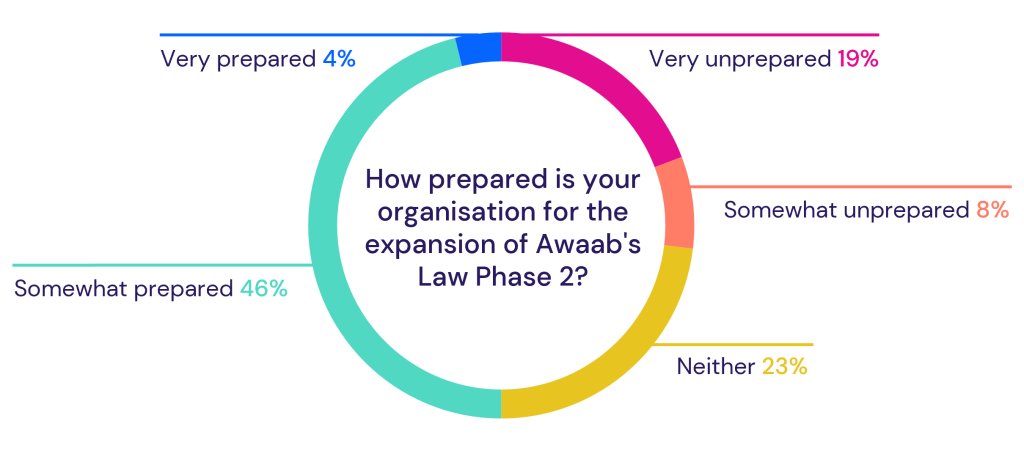
While some providers with advanced compliance teams are proactively “horizon scanning” and scenario-planning for Phase 2 hazards, many others report being in a holding pattern until they see clear regulatory guidance and definitive Phase 2 regulations. The majority of survey participants indicated neutral or low/medium confidence in their preparedness, with a number explicitly calling themselves “unprepared”.
This cautious stance stems from multiple factors. The expansion to new hazard types means processes proven for damp and mould now must be replicated (or re-engineered) for everything from fire risks to falls. Landlords are grappling with how to ensure expertise and capacity in each hazard area, often across different teams (repairs, health & safety, housing management) – a complex organisational challenge. Lack of surveyor resources was flagged as a major obstacle by some (since more hazards mean more inspections), and similarly the need for new training or roles came up across respondents.
What does this look like in practice?
The range of approaches taken to implement Awaab’s Law so far is striking. No single “off-the-shelf” solution has emerged, and many landlords are still refining their processes. Some have bolted Awaab’s Law requirements onto existing systems, while others have had to set up interim workarounds.
For example:
- Relying on an Excel spreadsheet until a dedicated module in their housing management software is implemented.
- A SharePoint-based hazard tracker with a third-party’s help to cope with Phase 1 data yet still felt only at a mid-point of readiness for Phase 2.
- Smaller organisations with smaller budgets report struggling to find the systems needed to track and monitor cases.
In short, the sector is experimenting with different tools – from CRM add-ons to manual trackers – to meet the data and reporting demands of Awaab’s Law.
Beyond technology, some landlords are introducing new teams or processes. For instance, one provider is establishing a dedicated “Hazard Team…to ensure works are captured and completed within timescale”, recognising that existing repairs and tenancy teams may not be configured to handle the unique coordination demands of Awaab’s Law cases across various hazard types.
Others have moved staff internally or brought in temporary specialist resources (e.g. damp surveyors and case managers) to tackle the initial surge of damp and mould cases and are now considering how to extend that approach to additional hazards in Phase 2.
Even dealing with fundamentals like access for inspections and works has proven challenging – one organisation highlighted that “meeting the timescales is difficult due to lack of access from tenants”, meaning that Phase 2’s success will also depend on strong resident engagement and, potentially, clearer legal mechanisms to gain access when needed.
The diversity of tools and tactics being adopted indicates a sector still seeking the optimal model for compliance. But it also highlights a risk of fragmentation: if each landlord devises its own interpretation of processes or hazard definitions for Phase 2, along with fragmented data collection and analysis, consistency and comparability could suffer, at least until regulatory guidance or best practice becomes clearer.
How does this affect cost and performance?
As social landlords pivot to meet these new requirements, there are both cost implications and potential performance impacts. On one hand, robust responses to Awaab’s Law could drive improvements in property condition and tenant safety metrics, potentially boosting Tenant Satisfaction Measures (TSMs) related to repairs and safety.
However, in the short term, significant investment in capacity and systems is likely to be needed. Many organisations anticipate the need for hiring additional surveyors, mould remediation specialists, or “hazard team” admin staff to handle the increased volume and breadth of casework. This comes at a cost, and timely recruitment is not always easy. As one respondent outlined, “Recruiting has been an issue, in finding people with the relevant experience/qualifications for Awaab’s Law”.
Financially, the cost of software upgrades and integration of new hazard-tracking modules may be considerable, especially for smaller providers. Those who already had modern housing management systems have often needed to purchase or activate specialised hazard management modules (e.g. damp and mould tracking or HHSRS modules). Others are developing interim Power BI dashboards or using external consultants to plug the gap. We’ve found that larger landlords tend to have an advantage in affording these investments, while smaller organisations may have to find creative solutions or share resources to cope.
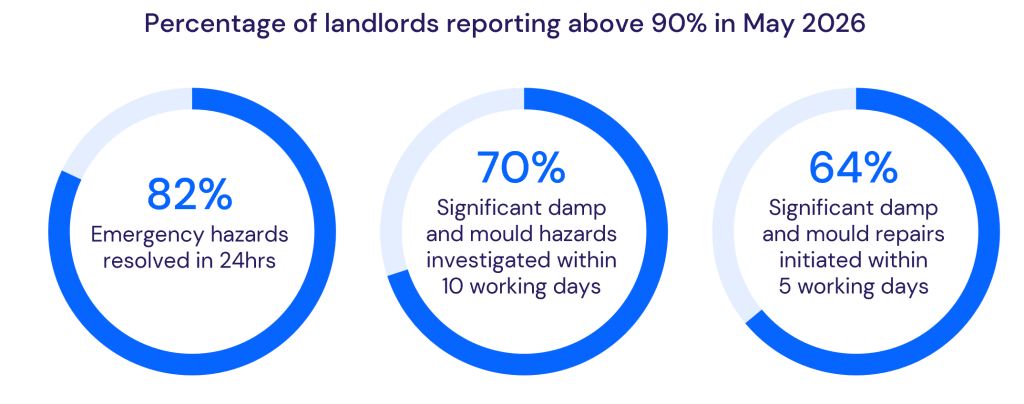
In terms of operational performance indicators collected through Pulse, the push to meet Awaab’s Law deadlines is already visible in the data. The percentage of emergency hazards resolved within 24 hours has held steady at above 95% since we started recording this metric in November. Resolutions for significant damp and mould hazards have been a little more variable as landlords embed new processes for these cases. After eight months of the new legislation being in place, 96% of significant damp and mould hazards were investigated within 10 working days and over half of landlords reported initiating 100% of repairs within 5 working days.
Our exclusive data reveals that landlord reporting is largely rising to the Phase 1 challenge, albeit at a cost – with many more re-prioritising activity and resources towards hazard response.
The importance of technology and data quality
However, this performance picture sits alongside persistent data quality challenges. One clear lesson from Phase 1 is that good data and systems are integral to success. A telling proportion of landlords have struggled to report comprehensive Awaab’s Law metrics from their systems, hinting at gaps in data collection despite their best efforts.
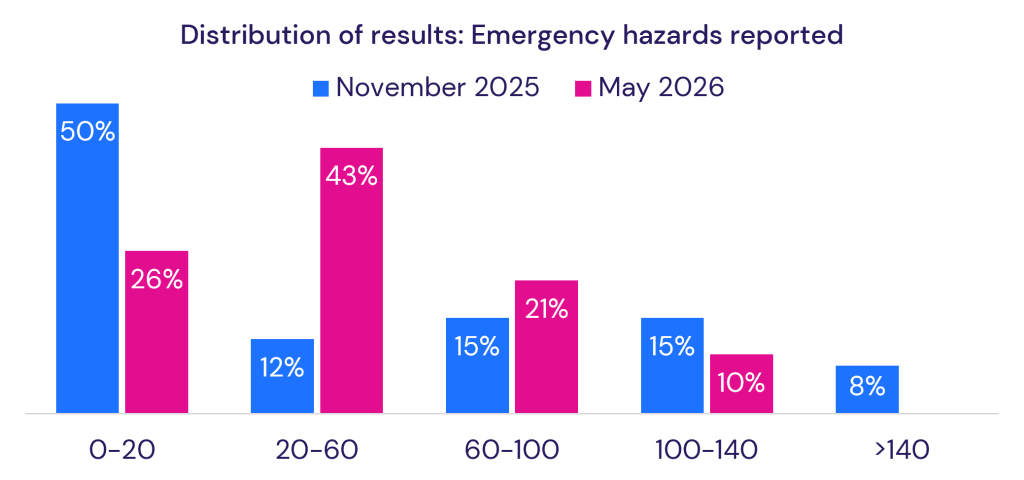
For example, emergency hazards are defined as posing ‘an imminent and significant risk of harm’ to the health or safety of the occupier in the social home. MHCLG guidance provides an example list of defects, setting the expectation that the approach to hazards should be in line with responses to emergency repairs. Our first month of data showed a wide variation in the interpretation of the guidance, with the rate per 1,000 ranging from zero to 160. TSM data on emergency repairs suggests that most landlords record rates between 20 and 100 per 1,000 units (with a median of 65).
Qualitative data we collected from landlords about their emergency hazards suggests that few were using the same process for Awaab’s Law emergency hazards as they were for emergency repairs. At the higher end of the range, contact centre staff were cited as triggering emergency hazards processes to err on the side of caution; while at the low end, emergency hazards were only counted if there had been a more formal investigation.
After working with our members to interpret MHCLG’s guidance as well as applying robust data validation criteria, the distribution of results reported to us in May 2026 is much closer to the levels we’d expect for this time of year.
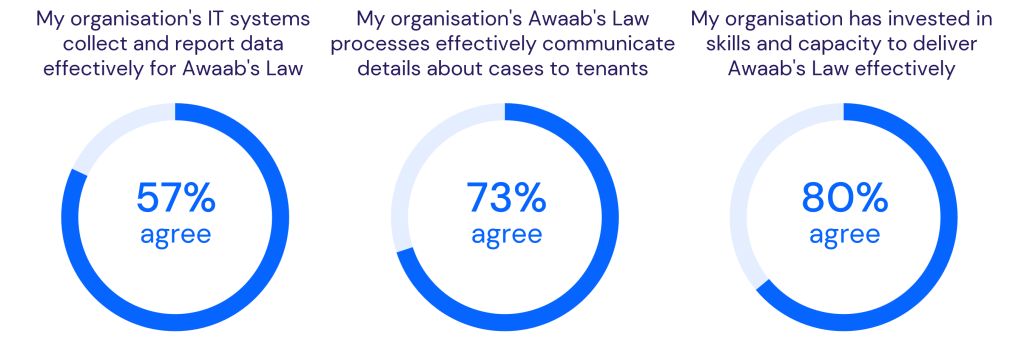
Our survey responses show that people and process are ahead of systems. Just over 57% of landlords now agree that their IT systems collect and report Awaab’s Law effectively, compared with 73% who say their process communicates case details to tenants effectively and over 80% saying they have invested in the skills and capacity to deliver.
For all the work that has gone into Phase 1, the weakest point is still the underlying infrastructure, with 43% of landlords disagreeing that systems are ready and effective for reporting. Should we be questioning whether the systems are mature enough to evidence it cleanly?
Landlords describe reporting that is still “very manual”, interim fixes built around spreadsheets while new systems are yet to be implemented, and integrations that are still catching up with operational reality. Responses to the survey point to written summaries, focus groups, training and extra admin support already being put in place.
The need for accurate data was a recurring theme in our survey. As one respondent explained, “Legacy systems and data limitations impact efficiency and reporting…there is a need to ensure the accuracy of data we hold on tenants and keep it up to date and consistent” – sentiments that echo the broad challenge of linking repairs, assets, and case management data for a 360-degree view of hazards. Some landlords also note that multiple systems that don’t talk to each other make it difficult to get that rounded view, emphasizing that data quality is as critical as technology itself.
For Awaab’s Law Phase 2, this means investing time now to refine data processes: ensure hazard cases are clearly logged and classified (e.g. by HHSRS category and risk level) at first point of contact, and that IT systems can flag and track every case through the required steps.
The government’s guidance explicitly reminds landlords that the Awaab’s Law deadlines are maximums, and not an excuse to delay work – adding that landlords must act sooner when circumstances require, keep clear records of all engagements and actions to demonstrate they have taken “all reasonable steps” to comply.
Meeting these expectations at scale will demand strong data discipline, joined-up systems, and refined processes, especially as hazard reporting becomes more frequent under Phase 2. Housemark are working with many landlords to improve data quality, compliance and assurance.
The operating environment
Eight months into Awaab’s Law and only months from Phase 2, social landlords are operating in a high‑scrutiny, low-tolerance environment. Phase 1 processes are largely embedded, with emergency hazards being resolved quickly, but attention has shifted to whether systems, data and capacity will stand up when scope widens. The legal duty is already live and uncompromising – landlords must continue to keep homes safe now under Awaab’s Law and the RSH Safety and Quality Standard, with immediate compliance required in the period ahead of Phase 2.
Our exclusive data reveals that performance is holding, but confidence is not: many providers describe a fragile equilibrium where compliance is being achieved through workarounds, manual tracking and short-term fixes, rather than fully scalable models. As one practitioner outlined, “we’re meeting the requirements, but the reporting is still manual and clunky – scaling this for Phase 2 will be very difficult”. Against this backdrop, the operating environment is characterised by a narrowing window to prepare, rising regulatory expectations, and limited headroom in already stretched services.
Key challenges surfacing now
 Preparedness gap for Phase 2
Most landlords describe themselves as only somewhat prepared or unprepared, driven by uncertainty around definitions (particularly hygiene hazards) and how Phase 2 will be assessed in practice.
 Data and reporting fragility
A significant minority are still unable to report complete emergency hazard volumes, raising concerns about assurance rather than delivery. As one provider reflected, “we’re confident the work is being done, but demonstrating it consistently is the challenge.”
 Systems not built to scale
Manual processes, spreadsheets and bolt-on modules are common. Several respondents warned that current setups “work for damp and mould but won’t cope with multiple hazard types.”
 Resource and skills pressure
Recruitment of surveyors and specialist staff remains difficult, while access constraints with tenants continue to threaten statutory timescales. One landlord summed it up: “timescales and access are our biggest risks.”
 Regulatory clarity vs. operational reality
While GOV.UK guidance is clear that landlords must meet existing duties regardless of phasing, providers are still reconciling overlaps between Awaab’s Law, HHSRS and the new Consumer Standards, often developing local interpretations in the absence of further detail.
3 things you can do today
Map and integrate the new hazards
Start now to embed Phase 2 hazards into your reporting and asset management frameworks.
Stress-test your processes and systems
Don’t wait for October- simulate a higher volume of hazard cases now to see if your current tracking mechanism holds up.
Build capacity and awareness
Consider establishing a cross-departmental Awaab’s Law team or taskforce relevant staff and employees to oversee implementation of Phase 2.
Unlock insights with trusted housing intelligence.