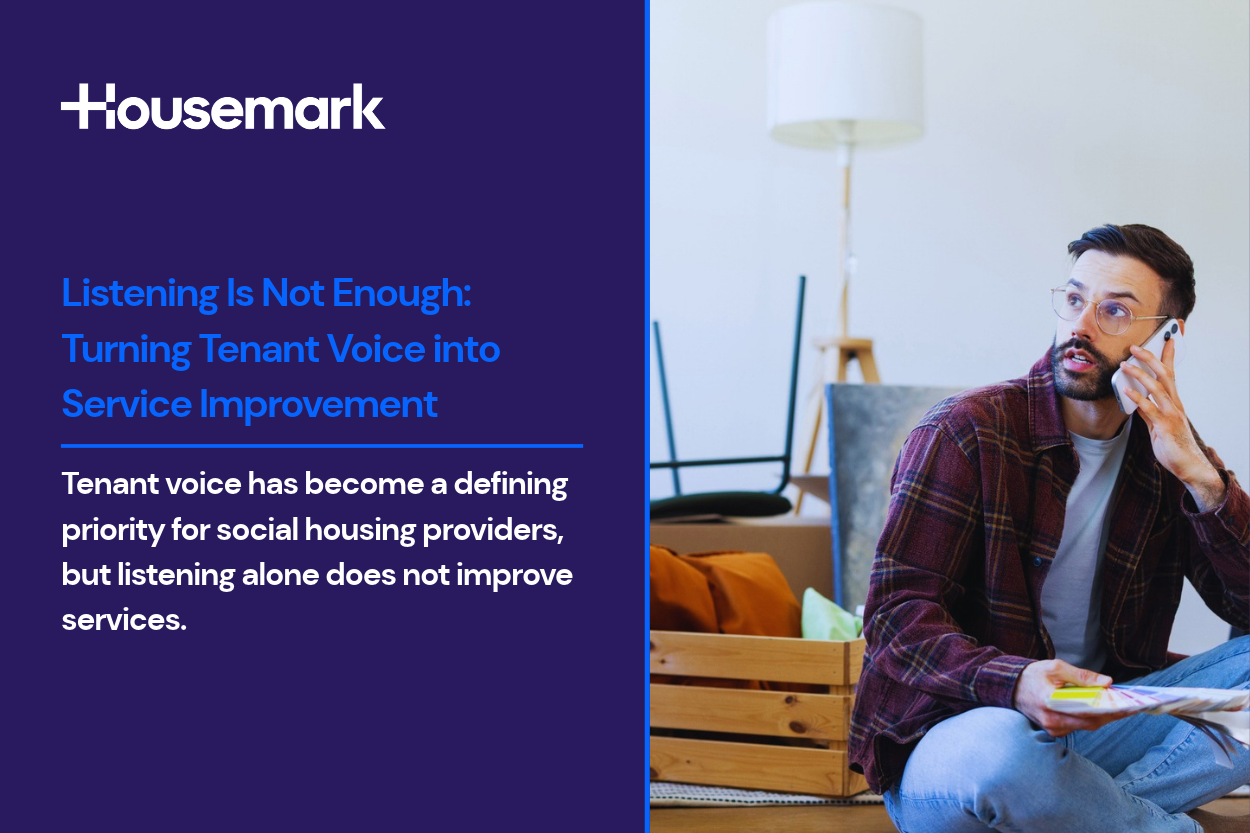
Tenant voice has become a defining priority for social housing providers, but listening alone does not improve services. This article explores why the link between resident feedback and organisational action often breaks down and what landlords can do to turn insight into measurable improvement. Listening well is necessary although it has never been sufficient.
The Good News: Listening Has Improved
Where the Handoff Between Voice and Action Breaks Down
Recommendations Without a Mechanism
Scrutiny panels produce recommendations; those recommendations are received, thanked, and — too often — quietly absorbed into a work programme with no clear owner, timeline, or tracking mechanism back to the panel that made them. Tenant representatives frequently report the same experience: they raised something, it was well received, and they have no idea what happened next.
When Tenant Voice Sits Outside Service Design
In many organisations, tenant voice activity runs as a distinct workstream alongside service improvement, rather than as an input into it. Service redesign happens in one part of the business; tenant panels operate in another; the two rarely meet at the point where a process is actually being rebuilt.
The Problem with Disconnected Evidence
Tenant voice output often sits disconnected from complaints data, TSM themes, and transactional feedback. A scrutiny panel might spend months examining a service area that complaints data would have flagged as urgent months earlier, simply because nobody is cross-referencing the different sources of resident evidence against each other.
Fatigue Among Residents and Landlords
Residents involved in scrutiny and engagement activity are often highly committed, which makes it particularly damaging when their input visibly goes nowhere. Landlords, meanwhile, can find themselves running tenant voice activity as a standing compliance function rather than continually asking whether it’s still generating genuine influence over decisions.
What Turning Tenant Voice into Improvement Really Requires
Closing this gap isn’t about running more engagement activity. It’s about building the connective tissue between voice and action:
- A clear, tracked mechanism that follows every tenant recommendation through to a decision — accepted, rejected, or deferred — with a reason given and reported back to the panel or forum that raised it.
- Deliberate points where tenant voice and service design meet directly, rather than tenant input being gathered and then handed over for someone else to interpret.
- Regular triangulation of tenant voice output against complaints themes and TSM data, so that resident-raised priorities are tested against — and help sharpen — the wider evidence base.
- Governance that tracks not just how much tenant engagement activity has taken place, but what has demonstrably changed as a result of it.
The Real Test of a Mature Tenant Voice Function
Where to Start: Assessing Your Customer Insight Capability
From Insight to Action
For many landlords, the first step is not another survey. The first step is understanding how effectively the organisation currently uses the customer evidence it already has. That is where a Customer Insight Health Check can add value.
The Health Check provides an independent assessment of how effectively a landlord collects, interprets, reports and acts upon customer evidence. It examines customer insight maturity across areas such as customer evidence, tenant voice, governance, decision-making, improvement and customer experience.
For organisations that need ongoing support, this can then lead naturally into Fractional Customer Insight Leadership: flexible access to senior customer insight expertise without the cost of employing a full-time Head of Insight.
Because the real challenge for many landlords is no longer listening. It is understanding, prioritising and acting.